

Signs Your Car Needs a Wheel Alignment
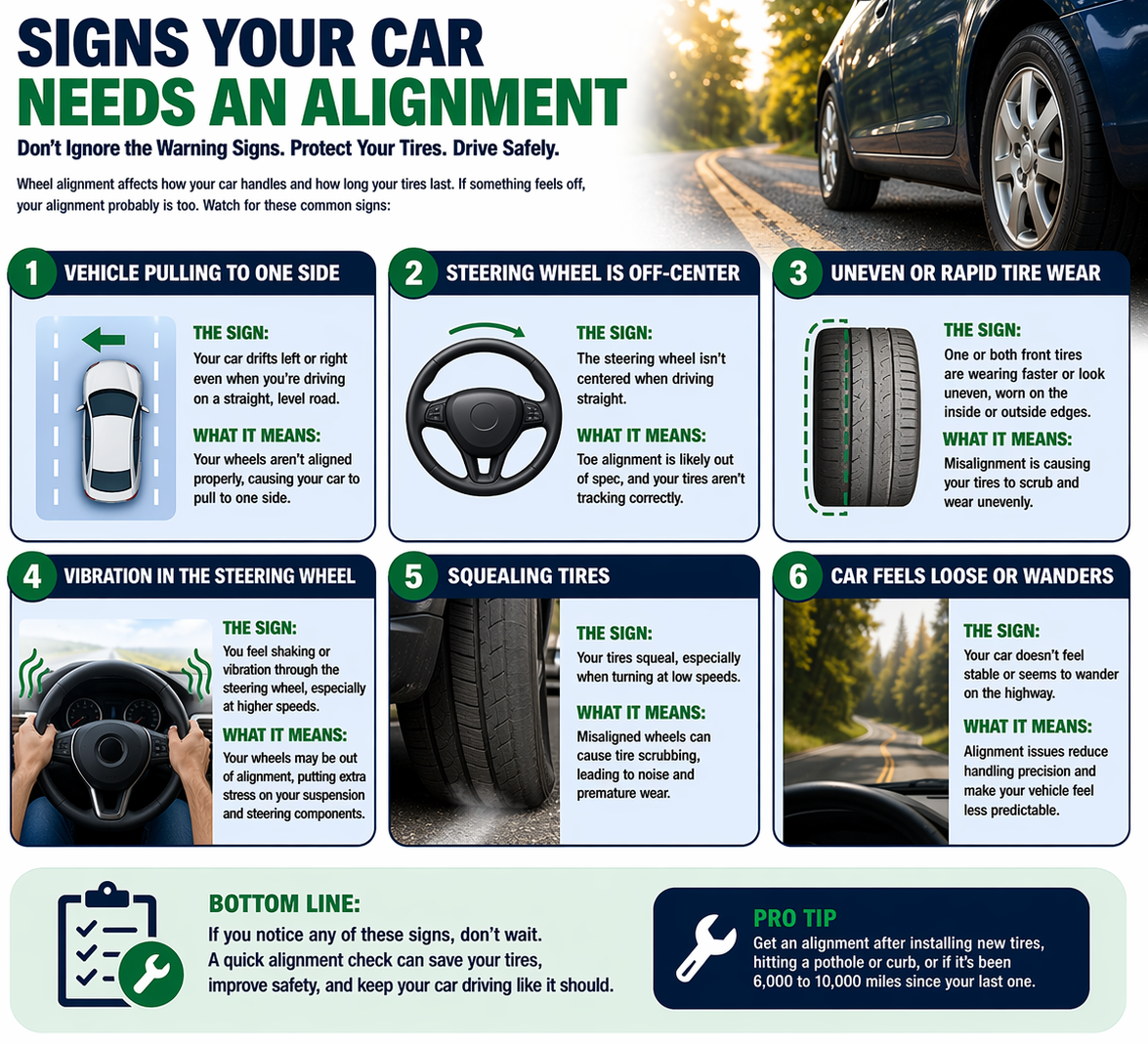
If your vehicle feels “off” but you can’t pinpoint the cause, there’s a good chance the issue is alignment-related. Wheel alignment isn’t just about keeping your steering wheel straight. It directly impacts tire wear, handling, fuel efficiency, and overall vehicle safety. Ignoring alignment issues can quietly cost you hundreds in premature tire replacement and unnecessary strain on suspension components.
Below are the most common signs your car needs a wheel alignment, along with what they mean mechanically and why they shouldn’t be ignored.
What Is a Wheel Alignment (And Why It Matters)
A wheel alignment adjusts three critical angles: camber, caster, and toe. These angles determine how your tires contact the road. Even slight deviations, often caused by potholes, curb impacts, or worn suspension components, can throw your entire system out of spec.
When alignment is off:
- Tires wear unevenly
- Steering becomes unstable
- Fuel efficiency drops
- Suspension components experience excess stress
This is why alignment isn’t optional maintenance; it’s a core part of responsible auto repair.
Your Car Pulls to One Side
If your vehicle drifts left or right when driving on a straight road, your alignment is likely off.
What’s happening:
The wheels are no longer parallel, causing uneven directional force. Even minor misalignment can create a constant lateral pull.
Why it matters:
- Reduces driver control
- Increases fatigue on long drives
- Accelerates tire wear on one side
If you’re constantly correcting your steering, it’s time to visit a trusted tire shop.
Uneven or Rapid Tire Wear
This is one of the clearest indicators of alignment issues.
Common wear patterns:
- Inner or outer edge wear signifies camber misalignment.
- Feathering (rough edges) is a sign of toe misalignment.
- One tire wearing faster than others means there is a directional imbalance.
Why it matters:
Tires are designed to wear evenly across the tread. Misalignment forces certain areas to carry more load, drastically shortening lifespan.
Pairing alignment service with routine tire rotations ensures maximum tire longevity and performance.
Steering Wheel Is Off-Center
If your steering wheel isn’t straight when driving straight, your alignment is off, no debate.
What’s happening:
Your wheels are pointing in slightly different directions, forcing the steering system to compensate.
Why it matters:
- Indicates improper toe alignment
- Can lead to long-term steering system wear
- Impacts overall driving precision
This is often one of the earliest warning signs drivers notice.
Steering Feels Loose or Unstable
A properly aligned vehicle should feel tight, responsive, and predictable. If your steering feels vague or “floaty,” something is off.
What’s happening:
Misaligned wheels reduce consistent road contact, affecting how your vehicle responds to input.
Why it matters:
- Compromises handling at highway speeds
- Reduces safety in emergency maneuvers
- Can indicate deeper suspension issues
If you’re already visiting for alignment, it’s smart to bundle a broader inspection with your next oil change or maintenance service.
Vibrations in the Steering Wheel
While vibrations are often linked to tire balancing issues, alignment can contribute, especially when combined with uneven wear.
What’s happening:
Misalignment causes inconsistent tire contact, leading to irregular rolling patterns.
Why it matters:
- Reduces driving comfort
- Can mask more serious issues
- Often paired with imbalance or worn components
A proper diagnosis at a full-service auto repair shop ensures the root cause is correctly identified.
Squealing Tires During Turns
If your tires squeal when turning (especially at low speeds), it could indicate improper alignment angles.
What’s happening:
Tires are being dragged slightly instead of rolling smoothly, increasing friction.
Why it matters:
- Accelerates tread wear
- Indicates incorrect toe settings
- Reduces traction and control
This is especially noticeable in tight turns or parking situations.
Poor Fuel Efficiency
This one flies under the radar, but it’s real.
What’s happening:
Misaligned wheels increase rolling resistance, forcing your engine to work harder.
Why it matters:
- Higher fuel consumption
- Reduced efficiency over time
- Increased strain on drivetrain components
Alignment is one of the simplest ways to improve fuel economy without modifying your vehicle.
Recent Impact or Suspension Work
Even if you don’t notice symptoms yet, certain events almost guarantee alignment issues:
- Hitting a pothole or curb
- Driving on rough roads
- Installing new tires
- Replacing suspension components
After any of these, an alignment check isn’t optional; it’s preventive maintenance.
How Wheel Alignment Connects to Other Services
Alignment doesn’t exist in isolation. It’s part of a broader system that includes:
- TPMS service: Misalignment can affect tire pressure readings over time.
- Car AC repair: While unrelated mechanically, car AC repairs are part of comprehensive vehicle health checks.
- Oil change: This is an ideal time to bundle inspections and catch early alignment issues.
- Brake service: Misalignment can affect braking stability and tire grip.
At MYKC Tires, alignment is integrated into a full-service approach rather than treated as a standalone upsell.
Why Drivers in Kansas City Trust MYKC Tires
At MYKC Tires’ Barry Road and Platte City locations, alignment isn’t guesswork. It’s precision.
You get:
- Certified technicians with decades of experience
- Advanced diagnostic equipment
- Transparent recommendations (no unnecessary services)
- Fast turnaround times
- Access to top-quality tire brands like Goodyear, Dunlop, and Kelly
Founded by Steve after years with Goodyear, MYKC Tires was built on one principle: Do the job right the first time.
Whether you’re dealing with uneven wear, steering issues, or just want peace of mind, their team ensures your vehicle leaves aligned, stable, and road-ready.