

Why Is My Car Burning Oil?
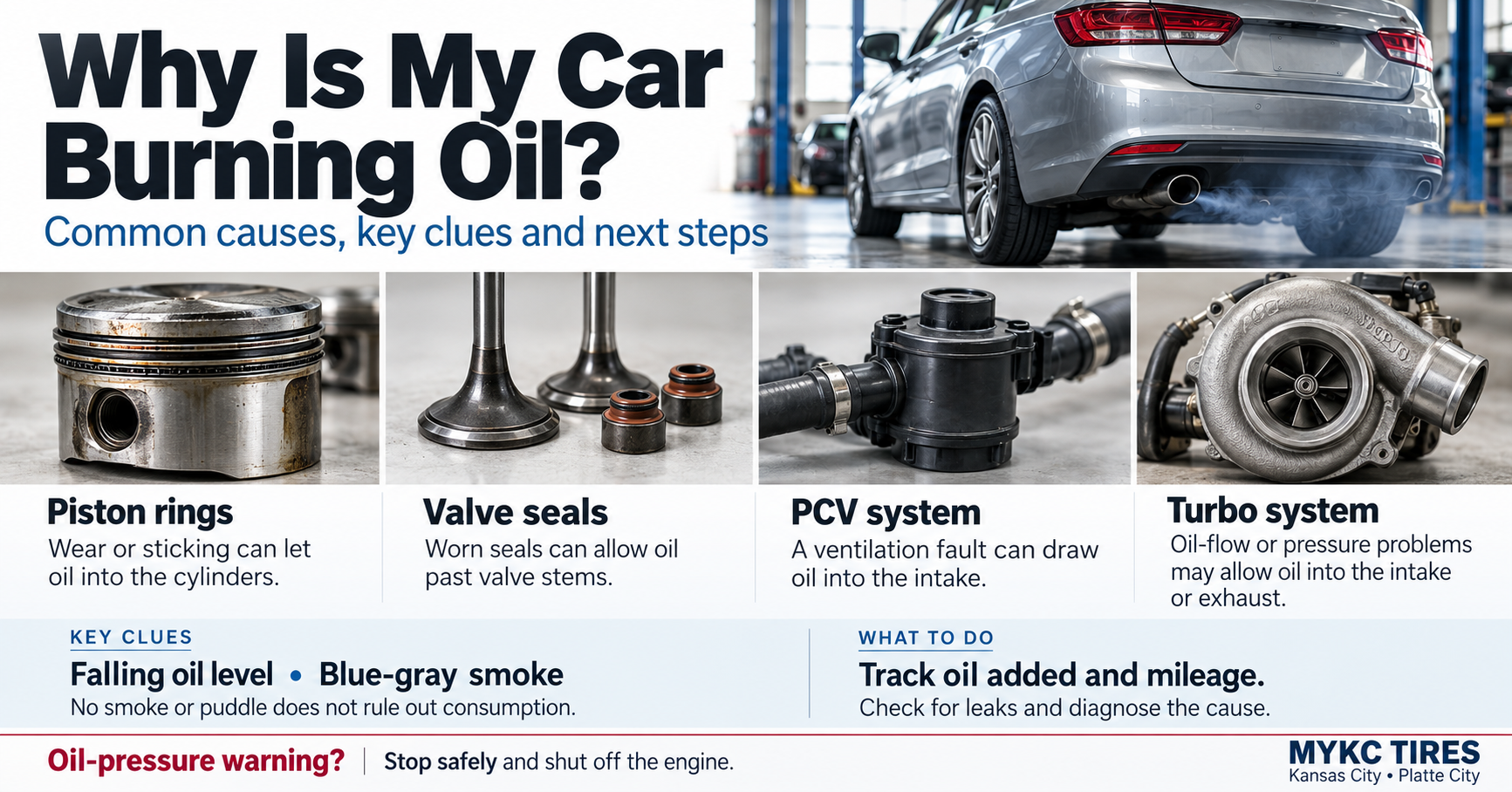
A car burns oil when engine oil reaches the combustion or exhaust process instead of remaining where it belongs in the lubrication system. Possible causes include piston ring problems, valve seal wear, crankcase ventilation faults, and turbocharger-related issues. The cause must be diagnosed before choosing a repair.
Oil burning can be obvious, such as a blue cloud from the exhaust.
It can also be subtle. You may discover that the dipstick level drops between changes even though the driveway stays clean and the engine seems to run normally.
That uncertainty often leads drivers to two extremes: assuming the engine is finished or assuming topping off is all that is needed.
Neither conclusion is justified without more information.
For Kansas City and Platte City drivers, the best starting point is to confirm the consumption rate, rule out external leaks, and identify the operating conditions associated with the symptom.
What Does “Burning Oil” Actually Mean?
Engine oil lubricates components that operate close to the combustion process.
The engine is designed to control how much oil reaches those areas.
Piston rings manage oil on the cylinder walls. Valve seals help limit oil movement along valve stems. The ventilation system separates oil from gases moving through the crankcase.
When these systems are worn, sticking, damaged, or malfunctioning, more oil may enter the air fuel path or exhaust.
The oil is then consumed rather than returning to the sump as usual.
A small amount of consumption can occur in some engines, but excessive or increasing consumption needs evaluation.
Burning Oil vs. Leaking Oil
An external leak releases oil outside the engine.
Oil burning involves internal consumption or oil entering a hot gas pathway.
The symptoms can overlap.
Oil leaking onto exhaust components can produce a burning smell and smoke under the hood without being burned in the cylinders.
An engine can also have both conditions.
That is why a diagnosis should not begin by assuming that every burning smell indicates piston ring wear.
Where the smoke appears, when it occurs, and whether there are visible leaks all matter.
Common Cause: Piston Rings
Piston rings perform several jobs, including sealing combustion pressure and managing oil on the cylinder walls.
Oil-control rings must move and drain properly.
Wear, damage, deposits, or other issues can interfere with that function, allowing more oil to enter the combustion chamber.
However, “bad rings” is not a conclusion that should be reached from a low dipstick reading alone.
The engine may have a different cause of consumption.
Testing must also be interpreted carefully. Compression tests are useful for certain questions, but they do not rule out every oil-control issue.
The goal is to develop a consistent explanation based on the symptoms and test results.
Common Cause: Valve Seals and Guides
Valve stems pass through guides, with seals controlling oil movement.
Wear or deterioration can allow excess oil to enter the intake or combustion process.
Smoke after startup or under certain operating conditions can provide a clue, but it is not a definitive diagnosis.
The same visible pattern may have more than one cause.
Repair requirements depend on the engine design and the condition of the associated components.
A shop should explain what evidence points to the valve system rather than making the recommendation solely based on exhaust color.
Common Cause: Crankcase Ventilation Problems
The crankcase ventilation system manages gases that pass the piston rings.
Many designs also separate oil from those gases before they enter the intake.
A malfunction can draw excessive oil into the intake or create abnormal crankcase pressure.
Depending on the engine, the system may include a separate valve, hoses, an oil separator, or components integrated into another assembly.
A ventilation fault may be less extensive to repair than internal engine wear, which is one reason diagnosis matters.
Replacing an engine without evaluating these systems would be premature.
Common Cause: Turbocharger-Related Oil Consumption
Turbochargers depend on oil supply and drainage.
Oil may enter the intake or exhaust when there is a problem involving the turbocharger, oil return, pressure balance, or associated engine systems.
A turbocharger should not automatically be replaced simply because oil is visible in an intake component.
The amount, location, system design, and underlying conditions all matter.
Garrett’s troubleshooting guidance emphasizes that turbocharger oil leakage can involve causes beyond the turbocharger itself. Source: Garrett
A complete inspection should consider the broader system before deciding on a repair.
Can Overfilling Cause Problems?
Yes.
Too much oil can affect crankcase operation and, depending on the engine, contribute to aeration or excessive oil entering the ventilation system.
Overfilling is not extra protection.
If the level is above the permitted range, have the quantity corrected and determine why.
A rising oil level can also indicate contamination rather than an overfill at service.
Fuel or coolant entering the oil requires diagnosis.
Do not assume every high reading can be solved by simply draining a little oil without investigating the circumstances.
Why You May Not See Blue Smoke
Visible smoke depends on the amount of oil, operating conditions, exhaust temperature, and emissions system behavior.
Consumption may happen mainly during acceleration, deceleration, startup, or sustained load.
You may not be behind the vehicle when it occurs.
A relatively small but persistent loss can also be difficult to see.
The dipstick trend and documented additions are therefore important.
“No smoke” is not enough evidence to dismiss a repeated drop in oil level.
What Does the Smoke Color Tell You?
Blue or blue-gray smoke can suggest oil burning.
Black smoke can involve excess fuel or air fuel problems.
Persistent white smoke may have several causes, including coolant-related concerns, while brief vapor in cold conditions may be normal condensation.
Lighting and exhaust conditions can make color judgments unreliable.
Use smoke as a clue, not a complete diagnosis.
Tell the shop whether it appears from the tailpipe or under the hood, whether the engine is cold or warm, and whether it changes with acceleration.
Those details are more useful than color alone.
How Much Oil Consumption Is Too Much?
There is no universal number for every engine.
Manufacturers may publish application-specific guidance or test procedures.
A change from the engine’s previous behavior can be important even before a published threshold is reached.
If the vehicle used little oil for years and now needs frequent additions, that change deserves attention.
Do not dismiss a worsening pattern because another owner reports similar consumption.
The vehicle’s condition and trend matter.
Track Consumption Before Guessing
Begin with the correct oil level.
Record the odometer and date.
Check using the same procedure each time and measure any oil added.
Also note towing, extended highway operation, long idle periods, or other unusual use.
If the shop requests a controlled consumption test, follow that procedure.
Avoid changing oil brands, viscosity, additives, and checking methods all at once. Multiple changes make the results harder to interpret.
Accurate records can save time during diagnosis.
Can You Keep Driving a Car That Burns Oil?
The answer depends on the rate and symptoms.
A vehicle with a stable, documented pattern may have a monitoring plan while diagnosis or repair is arranged.
However, rapid consumption, severe smoke, misfiring, unusual noise, overheating, or warning lights can make continued driving inappropriate.
An oil-pressure warning requires stopping safely and shutting off the engine.
Keeping extra oil in the trunk does not make every oil-burning condition safe.
It also does not protect the emissions system from all the effects of continued consumption.
Can Oil Burning Damage Other Parts?
Oil consumption can affect more than the oil level.
Deposits may develop on spark plugs and in the combustion system.
The emissions system can also be affected by prolonged oil consumption.
If the engine begins misfiring, continued operation may create additional risk for exhaust components.
The specific consequences depend on the engine and severity.
That is why a consumption problem should be evaluated before it produces a second, more obvious symptom.
Will an Oil Change Fix It?
A correct oil change can address unsuitable oil, an incorrect quantity, or overdue maintenance.
It will not automatically repair worn rings, failed seals, or a ventilation fault.
If the engine is consuming oil, mention it when scheduling synthetic oil service at MYKC Tires.
Otherwise, a routine appointment may be completed without the diagnostic work needed to explain the loss.
Maintenance and diagnosis are related services, but they are not the same service.
Can High-Mileage Oil Help?
An appropriate high-mileage formulation may help manage mild consumption in some engines.
It must meet the required specifications.
It cannot restore worn components or guarantee that a leak or consumption problem will stop.
If a formulation change is recommended, measure the result rather than relying on impression.
Continue checking the level and following the service schedule.
A reduction in consumption does not automatically establish that every underlying issue has been corrected.
Should You Use Thicker Oil?
Only if the manufacturer permits it or a qualified diagnosis supports an appropriate, approved change.
A thicker oil may alter symptoms without solving the cause.
It can also affect cold circulation and oil-operated systems.
Do not use viscosity changes to avoid investigating a sudden increase in consumption.
The same caution applies to aftermarket additives.
The engine’s requirements should guide the decision.
What Does Diagnosis Involve?
The first steps often include verifying the level and oil specification, reviewing service history, and checking for external leaks.
The ventilation system may be inspected.
Depending on the symptoms, the technician may examine spark plugs, intake components, or turbocharger-related systems.
Further testing can include pressure measurements, compression testing, leak-down testing, or visual inspection with specialized equipment.
Each test answers particular questions.
No single result should be stretched beyond what it can establish.
MYKC Tires provides auto repair and diagnostic services for drivers in Kansas City and Platte City.
Does Burning Oil Mean You Need a New Engine?
Not necessarily.
Some causes involve serviceable components outside the engine’s main internal assembly.
Other cases do involve substantial wear or damage.
The repair decision should follow diagnosis and consider the vehicle’s overall condition, estimated repair cost, and ownership plans.
A useful estimate explains what is known, what remains uncertain, and what the proposed work is intended to correct.
Avoid making a major decision based on smoke alone.
Fall Car Care: Resolve Consumption Before Long Drives
Fall road trips can make an oil consumption problem more noticeable because the vehicle covers many miles in a short time.
Before leaving, check the level and review the documented consumption rate.
Address unexplained changes and warning symptoms.
Also inspect tires, brakes, lighting, and cooling system condition.
The Car Concepts fall car care guide provides a broader preparation checklist.
You can arrange service through MYKC’s Kansas City or Platte City service information.
Frequently Asked Questions
Can a car burn oil without leaking?
Yes. Internal consumption may occur without an external leak.
Can it burn oil without smoke?
Yes. The consumption may not produce any obvious visible smoke.
Is a burning smell always internal oil burning?
No. An external leak onto hot components can also create an odor.
Will replacing the PCV valve fix it?
Only if a serviceable ventilation component is the cause. System designs vary, and diagnosis is necessary.
Should I wait until the oil light comes on?
No. Check the level as instructed. An oil-pressure warning can occur only after a serious lubrication problem develops.
Get Oil Consumption Diagnosed at MYKC Tires
If your car repeatedly needs oil between changes, document the pattern and arrange an inspection.
MYKC Tires can help distinguish a maintenance issue from a ventilation, sealing, turbocharger, or internal engine problem.
The next right step is to find the cause, not to assume the engine is finished and or that another top-off is a permanent solution.